
Blog
People Are Medicine: Why Recognizing Your Worth — and Everyone Else’s — Might Be the Most Powerful Health Decision You Make

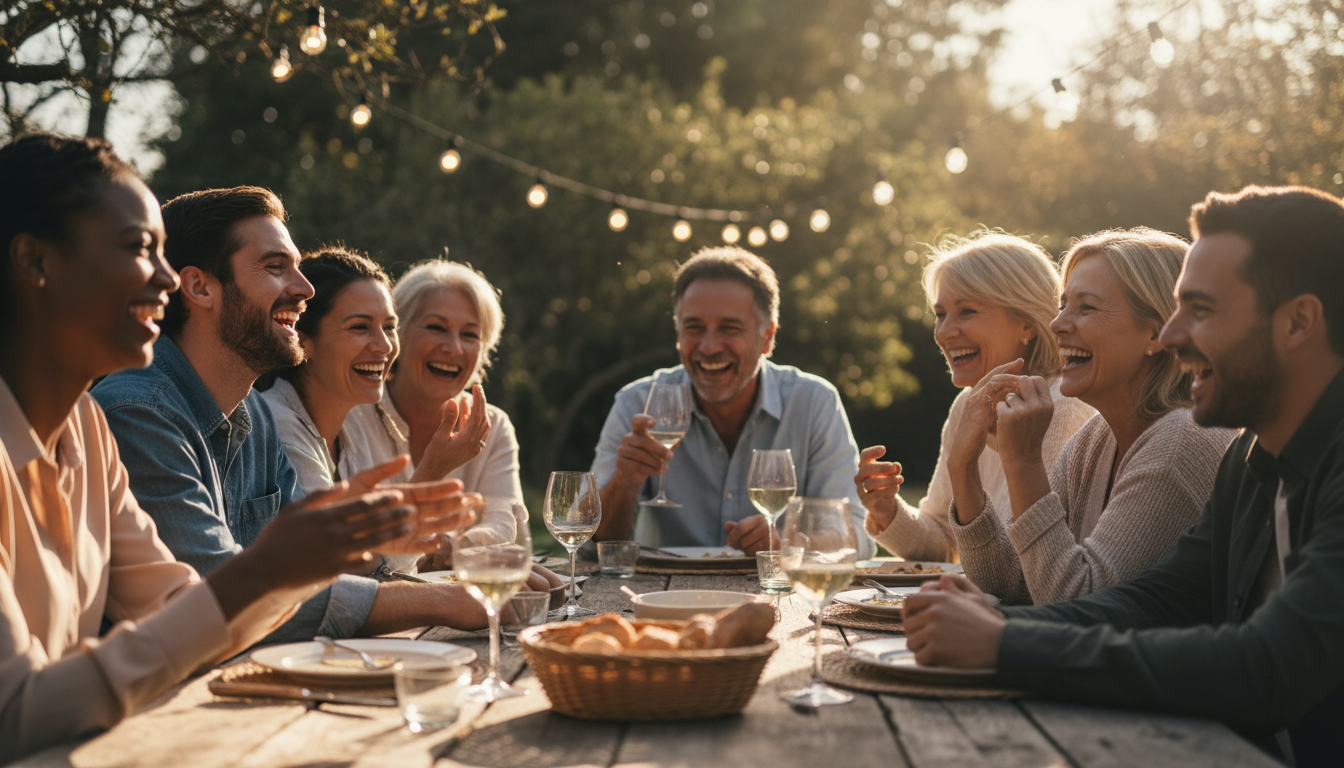
Here is something the wellness industry does not put on a label: people are medicine. Not supplements, not biohacks, not morning routines — people. Real, messy, imperfect, irreplaceable people.
Former U.S. Surgeon General Dr. Vivek Murthy spent years studying the American health crisis and arrived at a conclusion that surprised even him. In his book Together, he writes that loneliness is one of the most serious public health threats of our time — not because we lack access to healthcare or clean food, but because we have quietly stopped showing up for each other. Here is the part that stopped me cold: weak social connections carry a mortality risk comparable to smoking 15 cigarettes a day. Fifteen. That is not a soft wellness stat. It is something we already know in our bones — we need each other.
March 24th marks National Each Person Is a Person of Worth Day. We are living in an era of billionaires on magazine covers, Instagram feeds that look like luxury catalogs, and a quiet message that your value is tied to your zip code, your follower count, or the car in your driveway. We are also living in a moment where wars play out in real time on the same screens we use to order dinner — and somewhere between the scroll and the next breaking headline, we have grown numb to the fact that every person in every conflict zone is exactly that: a person. Someone's child, someone's parent, someone's neighbor.
The desensitization is not a character flaw — it is a survival mechanism in an age of relentless information. But it is worth naming. When we stop feeling the full weight of another person's humanity, we do not just lose empathy for people far away. We slowly lose the habit of recognizing the worth of the people right in front of us. That loss shows up not just in our communities, but in our bodies.
- Your worth is not negotiable. Self-worth is not earned through achievement or accumulated through stuff. Internalizing this changes how you show up for yourself and everyone around you.
- No one is better than anyone else. This is not a feel-good platitude. It is a foundation for the kind of human connection that research consistently links to longer, healthier lives.
- Loneliness is a health crisis hiding in plain sight. Dr. Murthy's research in Together argues that social disconnection is as dangerous as chronic disease — and that belonging is the antidote.
- Accessible community spaces make connection easy. Organizations like the YMCA were built around the idea that people of all ages, backgrounds, and life stages belong together.
- Small acts of recognition matter. Seeing people — really seeing them — is one of the simplest things a family can do, starting at home.
The Lie We Were Sold About Worth
Let us be honest about the world our kids are growing up in. They are watching which families take the biggest vacations, which houses have the nicest things, and which kids wear the right clothes. And somewhere along the way, many of them — many of us — absorb a quiet, corrosive message: that some people are worth more than others.
They are not.
National Each Person Is a Person of Worth Day, observed every March 24th, pushes back against that message. According to National Today, the day is rooted in the belief that every individual carries inherent dignity — not earned, not conditional, not measured in dollars or likes. It gives families a reason to sit down and ask the question we should be asking every day: Do the people in your life know that you see them? Do you know that you are seen?
Psychologists have studied the effects of social comparison for decades. Research consistently links upward social comparison — the kind amplified by social media — to anxiety, depression, and a diminished sense of self. When we scroll past curated feeds full of luxury and perfection, our brains do not register that it is a performance. They register it as reality and find us lacking.
The answer is not to log off forever. It is to build something sturdier inside — a sense of self-worth that does not wobble every time an algorithm serves up someone else's highlight reel. That sturdiness is built in relationship with others. It grows in families that name each other's strengths. It grows in communities where every person is welcomed, not ranked.
Start here, tonight: Tell someone in your life exactly one thing you genuinely value about them. Not what they do. Who they are.
We Are Wired for Each Other — And the Data Proves It
Dr. Vivek Murthy did not write Together as a self-help book. He wrote it as a physician who watched social disconnection quietly damage physical health at a population level. His argument is straightforward: human beings are biologically wired for connection, and when that connection is absent or shallow, our bodies pay the price.
The research he cites is hard to dismiss. People with strong social relationships have a lower risk of premature death. Social isolation raises the risk of heart disease, stroke, dementia, and depression. These are not side effects of loneliness — they are the direct biological consequences of a body not getting what it needs.
This matters for families because the habits of connection form early. Children who grow up in households where people check in, show up, and recognize each other carry those habits into adulthood. They build friendships more easily. They recover from stress more effectively. By nearly every health measure, they live longer.
This is not about being an extrovert or hosting perfect dinner parties. Murthy draws a clear line between the quantity of relationships and the quality. A few deep, reciprocal connections are far more protective than dozens of surface-level ones. What matters is that people feel genuinely seen and not alone.
Think about one relationship in your life that deserves more of your real attention — not a text, not a like, but actual time. What would it take to give that this week?
The YMCA Effect: Where Connection Just Happens
One of the most underrated things about a place like the YMCA is how naturally it brings together people who would otherwise never cross paths. On any given morning, you will find a seven-year-old in a swim lesson next to a seventy-year-old doing water aerobics. A teenager lifting weights alongside a retired veteran. A young mother in a fitness class exchanging knowing smiles with a grandmother who has been coming to the same class for twenty years.
This is not accidental. The YMCA was founded on the belief that community is built in shared space — that when people of different ages, backgrounds, and circumstances move through the same building, share the same pool, and cheer for each other's kids at the same swim meet, something real happens. Walls come down. Assumptions soften. People become people.
The research on intergenerational connection is consistent. Regular interaction between younger and older people reduces loneliness in both groups, improves cognitive health in older adults, and builds empathy and social confidence in children and teenagers. Programs that bridge generations — whether at a YMCA, a community library, a local faith organization, or a school — build the kind of social fabric that supports health across a lifetime.
For families, the practical point is this: you do not need to manufacture meaningful community from scratch. It is already happening in your neighborhood. The YMCA, the library reading program, the community garden, the neighborhood association — these are places where belonging already exists.
Seeing People: The Smallest Act With the Biggest Return
There is a moment most of us have experienced and never forgotten. A teacher who called you by name and meant it. A neighbor who noticed when you seemed off and asked. A stranger who held the door and made eye contact and said good morning like they actually meant it. These moments are small. They are also, neurologically and emotionally, enormous.
Being seen — truly acknowledged as a person of worth — activates the same brain pathways as physical safety. It signals: you belong here. You matter. You are not invisible. For children especially, repeated experiences of being genuinely recognized build the kind of self-worth that holds up under pressure — the kind that does not collapse the first time life gets hard or someone online says something cruel.
But this is not only about kids. Adults need it too, maybe more than we admit. The caregiver who never gets thanked. The parent who is holding everything together and quietly wondering if anyone notices. The coworker who has been going through something hard and just needs someone to ask how they are doing and wait for the actual answer. Seeing people costs nothing. It takes thirty seconds. And it is, in the truest sense, a health intervention.
The research on gratitude and recognition supports this plainly. Studies show that people who regularly express appreciation for others report higher levels of wellbeing, stronger relationships, and lower rates of depression. The act of noticing someone else's worth has a measurable effect on the noticer. This is a two-way door — and on the days when everything feels heavy, it is worth remembering that opening it helps you too.
Today, make eye contact with someone you might otherwise pass by — a cashier, a coworker, someone in your household — and say something that lets them know you actually see them.
The research shows that weak social connections carry a mortality risk comparable to smoking 15 cigarettes a day. People are not a soft wellness strategy — they are the strategy.
Dr. Vivek Murthy, Together
One Small Step (Because That Is Enough)
Not every suggestion below will fit where you are right now, and that is completely fine. Pick one. Just one. That is enough.
- Tell one person one true thing about who they are — not what they’ve done or what you value them for, but something you genuinely value about them. Do it today, even if it feels awkward.
- Put your phone down for ten minutes at dinner — not as a rule, not as a new habit, just once. See if the conversation goes somewhere unexpected. If you already do that, then leave it in another room during dinner.
- Look someone in the eye today who usually goes unnoticed — the person at the checkout, the neighbor you always wave to but never really talk to, the coworker who always eats lunch alone. Say something real.
- Find one local community space and look up what they offer — the YMCA, the library, a community center, a faith organization. You do not have to go yet. Just look. Let it if feel possible.
- Let yourself be seen, too — reach out to one person today and tell them honestly how you are doing. Not the fine version. The real version. Connection runs both ways, and you deserve it.
- Share this day with your kids — tell them about National Each Person Is a Person of Worth Day, and ask who in their life might not be seen enough. Then listen. Really listen.
Closing Thought
You don’t have to overhaul your life. You don’t have to become someone who has it all figured out. The research is clear, plainly and urgently: the most protective thing you can do for your health and your family’s health is to keep showing up for each other. To keep seeing each other. To keep saying, in small ways and large ones: you matter. You are not invisible. You are worth something just by being here.
That’s what today is about. That’s what every day could be about, if we let it. Happy National Each Person Is a Person of Worth Day — and if no one has told you yet today, hear it here: you are seen. You are enough. Go be someone’s medicine.
References
Murthy, V. H. (2020). Together: The healing power of human connection in a sometimes lonely world. Harper Wave.
National Today. (2024). National Each Person Is a Person of Worth Day — March 24. https://nationaltoday.com/national-each-person-is-a-person-of-worth-day/
Holt-Lunstad, J., Smith, T. B., & Layton, J. B. (2010). Social relationships and mortality risk: A meta-analytic review. PLOS Medicine, 7(7), e1000316. https://doi.org/10.1371/journal.pmed.1000316
Vogel, E. A., Rose, J. P., Roberts, L. R., & Eckles, K. (2014). Social comparison, social media, and self-evaluation. Psychology of Popular Media Culture, 3(4), 206–222. https://doi.org/10.1037/ppm0000047
Belgrave, M., & Bannan, K. (2020). Intergenerational programs: A review of the research on outcomes for older adults. Journal of Intergenerational Relationships, 18(1), 66–85.
Emmons, R. A., & McCullough, M. E. (2003). Counting blessings versus burdens: An experimental investigation of gratitude and subjective well-being in daily life. Journal of Personality and Social Psychology, 84(2), 377–389. https://doi.org/10.1037/0022-3514.84.2.377